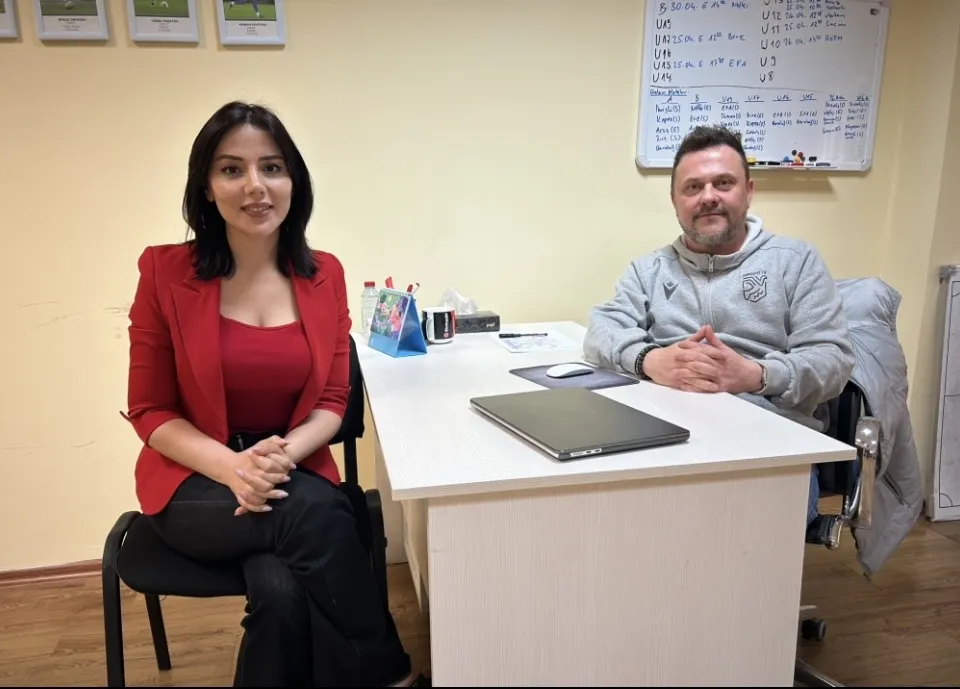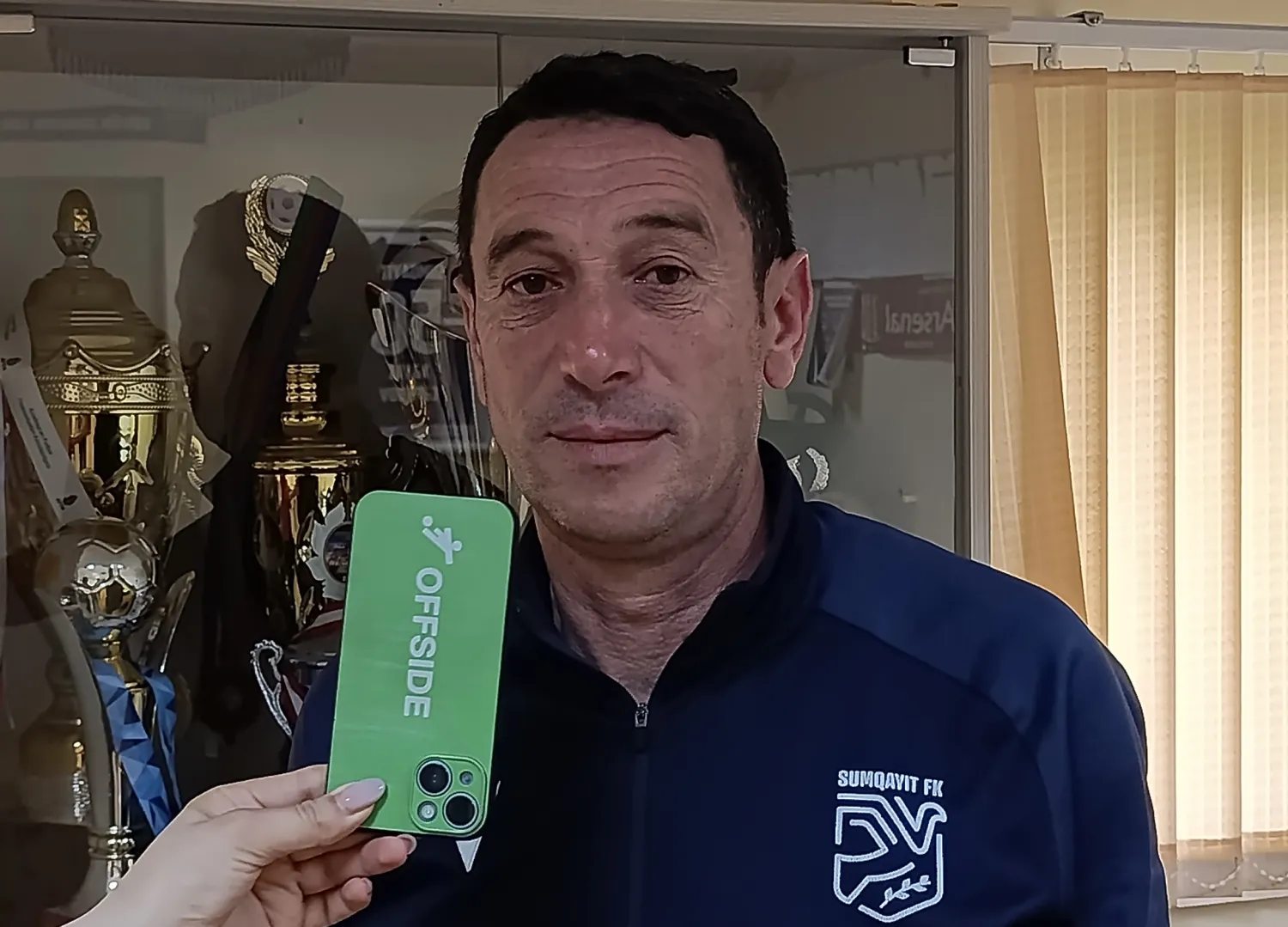

We present to you the second part of the interview given by Hakan Sunal, Director of the Sumgait Football Academy, to Offsideplus.az:
Surely, during your time leading the academy, there have been people approaching you trying to influence your decisions with external favors. I wonder, how did you react in such cases?
You touched upon a very good topic. When I was in Germany, I never encountered the concept of nepotism or outside interference. They will never tell you, "you have to take this kid" or "he is so-and-so’s guy." Out there, they say that if a child is unfit for this field, then he is unfit. Even if he were the king’s son. Perhaps that is why their pace of development is so high.
When I first came here, I didn't know how to react to such things. Maybe my biggest advantage is that in the end, they can blame me by saying, "he is a foreigner, he doesn't get it." If you give in once or twice, it will keep happening. If you can come to training, come, but I am the one who makes the final decision whether to accept you or not. One must not lose their sense of reality.
How do you tell a parent, or even the child himself, that they are not cut out for football?
There are no problems until the age of 15 because the number of teams is large. The breaking point starts after 15. We are the only team representing a big city like Sumgait in the Premier League. For this reason, we created a second team to enter competitions so that those kids wouldn't drift away and get lost.
Parents are also slowly realizing that football is a pyramid. As you move up, it becomes more or less clear whether this child can reach the top or not. The problem is that the number of teams in the Premier League is low. When I first arrived, there were 10 teams in the Premier League, making 18 teams in total along with the lower league. Multiplying this by 20 means roughly 300 players. This means that in a country of this size, there are only 300 spots to play professional football. Meanwhile, I have 300 children in my academy alone.
In fact, one of the biggest problems is the lack of teams at the professional level. However, successful work has been carried out in this direction over the years. The Second Division and the Reserve League were established. We are on the right track.
As for your question, in such cases, we tell the children that if it didn't work out here, it might work in another league. I always tell parents that you cannot build everything around football. No matter how talented a footballer you are, your football career can end one day with a single injury. Therefore, my advice to parents is not to pin all your hopes solely on football. Pay attention to education and career choices in parallel.
For instance, in Germany, most professional footballers either have an additional profession or a higher education degree. We also plan to do some work in this direction in the coming years. For example, we organize field trips for our lower age groups to various plants and production workshops of the Azerikimya Production Union. In other words, we want to show the children other directions of working life in parallel, to show them that if it doesn't work out here, there is another choice.
Children at the Sumgait academy do not live permanently at the base. We know that this system has many benefits in terms of controlling the nutrition and sleep schedules of footballers. For example, we have the Gabala Football Academy model, where this system has been applied for years. Do you not see a need for this, or do current conditions not allow it?
If we are talking specifically about the Gabala example, we can say that because football was weak there, there was a need to create such a base. A certain investment was needed to gather the children in one place. But we see that this strategy is already running out of steam. If that academy operated today the way it used to, it would be very good in terms of competition. But the Gabala academy is not what it used to be. Look how far it has fallen...
The reason is that the strategy was built on money. With us, it is not like that. If we were to build a training base, I would be happy. This has many positive aspects. However, let's take into account that we live in Sumgait, not Gabala. We have enough potential children.
Also, the problem in Gabala is that they take 9-10-year-old children out of their social lives and gather them in a base. Most of the children there come from the surrounding regions. In Sumgait, however, children can come to training and return home within half an hour at most.
If such a system were to be created here one day, I would prefer it to be applied only to children over 15. It is very important that this method is used for upper age groups. In Europe, they do not recruit 11-12-year-old children into boarding-school-type dormitories. First of all, parents do not allow it. It is very crucial for a child to develop in their natural environment.
For example, we also have a few children coming from distant regions. We have placed them in a boarding school near the academy. But the number of such children is small.
How do you assess the academy's participation in international competitions?
We attach great importance to this direction. Our various teams frequently participate in international competitions. Recently, we participated in tournaments held in Turkey, Qatar, and Kyrgyzstan. We also went for a study visit to Belgrade with our U-19 coach. It was very beneficial for us. Furthermore, our academy coaches frequently join online seminars.
In your opinion, what is the main problem slowing down the development of football in Azerbaijan?
There are plenty of talented footballers in Azerbaijan; the problem lies in the direction. You need to be patient to see results. The history of Azerbaijan's independence is 30 years. How many generations of footballers can you raise during this period?
Now let's look at Europe. For example, the German Football Association was founded in 1903, and the English Football Association has been operating since 1870. We are still in the development process. We can evaluate the results of the work done today at least 10 years later.
We need to develop football culture. Sometimes more people come to academy matches than Premier League games. Believe me, this will also change over time. Those parents will come a day when they watch their children in the stadium.
For instance, when I first came here, Elvin Jafarguliyev was playing for us on loan. Not many people knew him back then. But I saw the talent in him to play big-time football. Years later, he proved it.
Currently, I see Nadir Orujov as a starting lineup player. I believe that three or four years from now, he can also become a player of Cafarguliyev's level.
It is pleasing that there is a special focus on women's football in your academy. What are your priorities in this direction?
Our work in women's football is going very well. Recently, I was a guest at one of the girls' football clubs located in Germany. There, they gifted me 10-12 pairs of boots, and I brought them here and distributed them to our girls. Such nuances are a motivation for children.
The situation of women's football in Azerbaijan is better than men's football. This is not what I say; FIFA and UEFA rankings say so. And just imagine that a professional approach to women's football is not even fully there yet. If more attention is paid to this area, we can achieve serious success.
Currently, we have girls' Under-14, Under-16, and Top Division teams. I really want to create an Under-12 team in the near future because the number of talented children at younger ages is also high.
For example, we have 10-year-old Nuray, who is very talented. We even applied to AFFA for her to compete with boys and received a positive response. Following that application, girls were allowed to participate in the Under-12 boys' league as well.
We also have a 13-year-old girl named Zeynab, who is highly talented. Zeynab could become the Ronaldo of Azerbaijan in the future.