
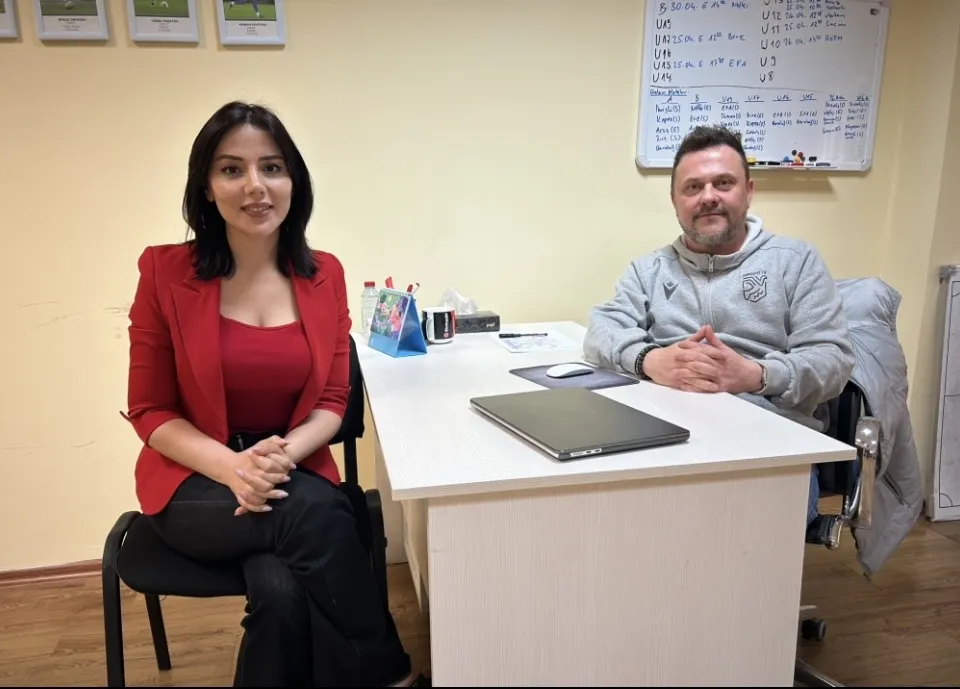
The director of the Sumgait Football Academy, Hakan Sünal, gave an interview to Offsideplus.az.
How is work going at the Academy?
We are continuing our journey with the usual ups and downs.
Would you say you are currently in a "down" or an "up" phase?
Looking at our strategy, I can say that certain problems arise from time to time. But overall, everything is in order.
This year, we saw many academy graduates in the main team. Considering the role of this issue in Sumgait club's strategy, can we call this a successful season for the academy?
Yes. It's true we didn't win championships, but we provided 6 players to the first team. That is our championship. Since the academy was founded, 13 of our players have appeared in the Premier League. This is a significant figure. We want to increase these numbers in the coming years. Naturally, we also expect championships as a validation of our path.
You have been at the helm of the academy since 2019. Seven years working in another country is not a short time. Was it difficult to adapt to Sumqayıt?
I grew up in Germany, not Turkey. I worked in various academies there for years. Therefore, when I came here, I brought German experience and work principles. I try to apply the experience I gained during that period in a way that fits Azerbaijan. Naturally, not exactly the same, because there is a difference in mentality. The adaptation process took about six months. Unfortunately, just when I wanted to focus fully on the work, there was a long break due to the pandemic. However, we made good use of that break and worked on our strategy. As a result, we had consecutive successful results after the pandemic. As the years go by, I am becoming more accustomed to the local mentality.
You mentioned bringing foreign experience. How did local specialists react to the innovations you wanted to implement?
I saw that older coaches relied more on Soviet-era templates, while younger ones were open to innovations. I felt this most when setting up new departments. Some coaches were worried about losing their positions. However, after a while, the coaches accepted the division of labor. Today, we have reached a stage where coaches themselves approach analysts and fitness coaches for help. Innovation is always hard to accept, but we have already passed satage.
While at the Academy, I visited the video-analysis department. They mentioned it has been operating for three years and was created on your initiative. It probably wasn't easy to build something from scratch in a field with no tradition.
Of course. For example, when I first arrived and said I needed an athletic coach, they laughed and asked, "Are we preparing for the Olympics? What does this have to do with football?" It turned out there were no experts in this field in Azerbaijan. So, I started researching it myself. I inquired with various specialists and spoke with professors working at the Sports Academy. They recommended a student of the academy—Mr. Bagdan, who works with us now. They mentioned that although he was a 400m runner, he had no connection to football. I met him, and that’s how we started; over time, the football direction was completed. Over 5-6 years, we developed two professional fitness coaches. I should also note that a fitness coach doesn't just look at running techniques; they track the physical development of the players. Our players undergo tests twice a year, and we create training plans based on those results. One of the most serious problems in Azerbaijani football is the lack of a database in this direction. Unfortunately, this problem is still relevant today. For instance, if you want to look at Mahir Emreli’s academy statistics now, you won't find anything. In such a case, how can you track a player's development? People have reached today based solely on sight and intuition. In Europe, work has been based strictly on data for many years. This is a very important point for a player's development. We created the video-analysis department to monitor processes happening on the pitch during a match. We started from scratch here as well.
How did you find the specialists for this?
First, I found someone who understood football and knew how to work with video. He started with a regular camera. But that is also very difficult. How many matches can one person film with a standard camera? So, it was very hard at first. Even if matches were filmed, the analysis took a long time. In the second year, we bought a "Veo" camera. Additionally, we recruited another staff member. Later, we sent both of them to a video-analysis program in Turkey. The best part about the "Veo" camera is that it works with artificial intelligence; there’s no need to turn it left and right like a wedding camera. It stays fixed and captures the game episodes. In short, this camera has made our job much easier. I should mention that from next season, AFFA will purchase "Veo" cameras for clubs. This is truly a vital issue for the development of football.
I understand that you are very sensitive about choosing specialists. What specific points do you look for when recruiting a coach to the academy?
First and foremost, a coach must identify themselves with our academy.
Meaning?
Meaning their mind and heart must be with the club. That is why 99 percent of the coaches working in both our club and our academy are from Sumgait. When we look at other clubs, we see specialists from various regions, but that’s not the case with us.
So, there’s a "green light" for people from Sumqayıt at "Sumgait"?
Naturally, quality is also an important factor. We also have coaches from Baku.
But when caught between a choice, does someone from Sumgait have a better chance? Is that correct?
Look, they live here, they know.
(PART I)