
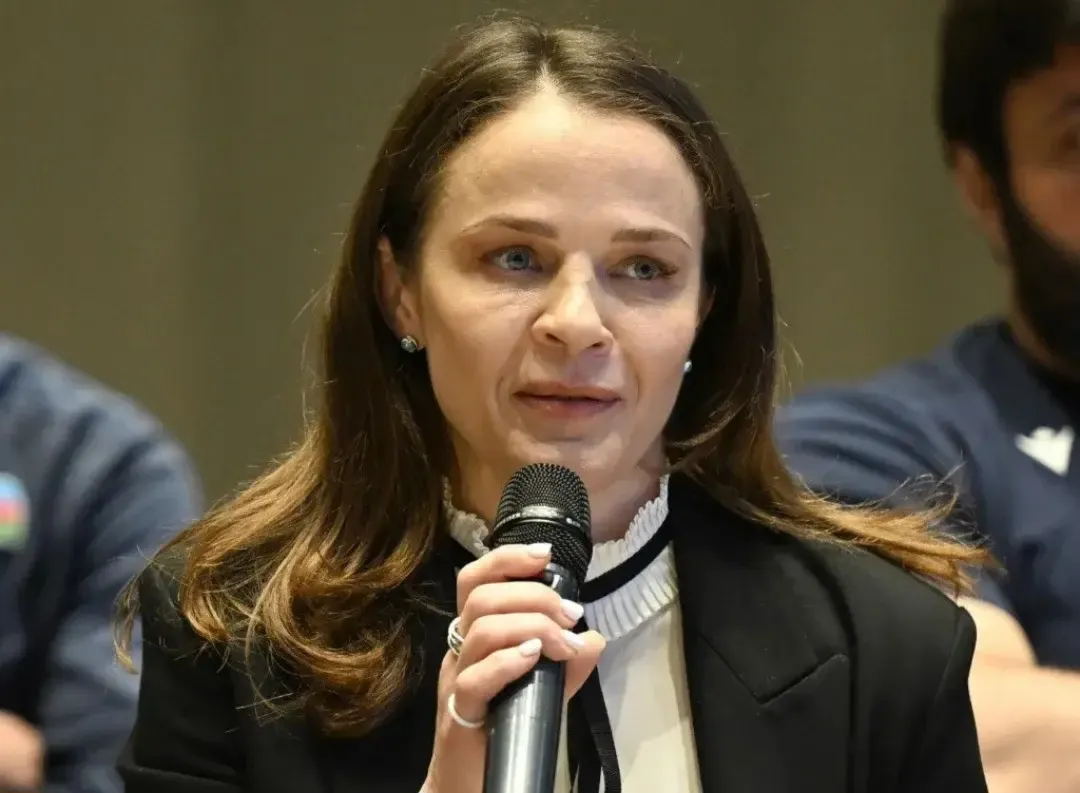
Mariya Stadnik, a four-time Olympic medalist in women's wrestling, two-time world champion, ten-time European champion, and the only female wrestler to have participated in five Olympic Games, as well as the women's wrestling coordinator of the Azerbaijan Wrestling Federation, gave an interview to Offsideplus.az.
"GIRLS LOWER THEIR HEADS WHEN THEY SEE MALE COACHES"
Last week, the Azerbaijan Championship was held in Astara among 15- and 17-year-old girls. This was the first time in Azerbaijan’s women's wrestling history. What can you say about the level of the championship?
I first came to Azerbaijan in 2007. Since local girls couldn’t engage in wrestling at that time, they recruited legionnaires like us to the national team. We served as role models for local girls in wrestling. Finally, after 18 years, the first Azerbaijani women's wrestling championship was held. This makes me very happy. We managed to find enough girls to organize a championship. Previously, girls were called up to the national teams, but there were only 1-2 athletes per weight class.
It seems there were still similar problems in some weight classes this time as well?
Yes, especially among the 17-year-olds. But still, organizing a championship is a very positive development. Now, other girls will have motivation too. The winners of the national championship will participate in the European Championship. Unlike before, they are no longer just training in gyms without any goal. There was no championship, no selection before. So why would they train? For beauty? It is important to hold more tournaments among girls. I feel their interest in wrestling growing. Moreover, competitions and medals give great motivation to young girls.
Are you planning to visit different cities and regions of Azerbaijan? Because hearing about your name is one thing, but seeing Mariya Stadnik in person is another. For example, the announcement "The living legend Mariya Stadnik is coming to meet you" would be very motivating, especially for girls in villages and small towns, boosting their self-confidence.
Honestly, I haven’t had time for such visits yet. I've only been working in the federation for 2 months. During this time, I have been busy with foreign trips, training sessions, and meetings. When I was wrestling, I never thought about the system's inner workings — which schools, clubs, or coaches existed for women's wrestling. The main purpose of organizing the championship was to gather the girls from different parts of the country in one place. Some coaches would message, claiming they had 100 girls training in their groups. But at the national championship, neither the coaches nor the athletes showed up. We don't need fake information like that. We want to see the real situation. Now, I plan to gather the coaches of the champion girls. Later, I will travel to cities and regions to observe the athletes during training. I am especially interested in the activities of children's coaches because youth coaching is fundamental in this sport.
What challenges are there currently in women's wrestling in Azerbaijan?
Most girls lack self-confidence. As soon as they see male coaches, they get shy and lower their heads. This is probably due to cultural mentality. They don't believe that as women they can be strong and achieve results in sports. This situation irritates me. I don't know why it’s like that — as if women can't succeed.
Azerbaijani Medina Bayramova won a gold medal at the German U-17 Championship. Is it possible for her to join our national team? In general, do you plan to recruit Azerbaijani-origin female wrestlers from abroad?
For now, we want to set up the system properly here. We organized the Azerbaijan championship and determined the strongest athletes. So, when we take someone to the European or World Championships, it will be a fair selection, and no one can object. We are interested in recruiting Azerbaijani female wrestlers from anywhere in the world. I have heard about Medina Bayramova. If she wants to represent Azerbaijan, she will need to participate in the national championship or go through a selection process. Only after that will her situation be officially resolved.
"MY DAUGHTER HAD NO PATIENCE FOR WRESTLING"
Ms. Mariya, now some personal questions. You mentioned earlier that at the last European Championship, you saw how hard it was for girls to cut weight. Now you don't have that stress. Are you still careful about your diet? Are you afraid of gaining weight?
I guess I will always be afraid of gaining weight. I have always been careful about my weight. I used to wrestle at 48 kg and later at 50 kg. Even though I ate normally, I would weigh myself every morning and night. My scale still stands next to my bed. I check my weight as soon as I wake up. After giving birth, I gained weight. Weight issues have always been on my mind. These fears have stayed with me. Currently, my body is resting and releasing all the stress. So far, I haven’t gained extra weight — I am fighting it (laughs). Every day, I try to do at least 15-20 minutes of exercise. But, of course, this is according to my own mood, different from intense training camps. I have some health issues too. My blood pressure drops frequently. I have done blood tests and take necessary vitamins. I exercise in the fitness gym to stabilize my cardiovascular system. My body was used to heavy loads. After the Paris Olympics, both physical and psychological exhaustion led to these problems.
Now you can eat whatever you want.
In principle, I eat whatever I want but in moderation. It's not like I came from a starving country...
Was there ever a situation where, because of your professional career, you couldn't eat something you craved for years and now finally allow yourself to?
There were restrictions before. For example, if I had a full plate of food in front of me, I would think whether to eat all of it or just half. Now I tell myself: "How nice that I don't have to think about the quantity anymore." Besides, I am not a big eater. The athlete’s discipline has become a habit for me.
You have a son and a daughter. Was it difficult for them to adapt to Azerbaijan?
The first year was very difficult for us. When looking for a school, I chose a Russian-speaking school rather than an Azerbaijani one. I thought we would only stay for a year and return. My children can communicate in Russian, but grammar is hard for them. Once, my son's teacher called me and asked why he speaks Russian well but writes poorly. I explained: "He can talk fluently, but grammatically, it’s difficult for him — please don’t criticize us for that." Once, my son came home saying he no longer wanted to speak Russian. But now everything is fine.
Is your daughter following your path?
Neither of my children is involved in wrestling. My daughter used to go to gymnastics. I even took her to wrestling practice a few times — she was good at it. But she didn’t have the patience for wrestling. And frankly, I didn’t have the patience or nerves to watch it either. I said: "Daughter, let's keep peace at home, neither you get upset nor I." That’s how her interest in wrestling disappeared. Now she does dancing and plays volleyball.
"MY SON CAME HOME AND SAID HE WOULD NEVER GO TO FOOTBALL PRACTICE AGAIN"
Recently, a video surfaced where you said your son had to leave his football club. Was it an Azerbaijani or Ukrainian club?
An Azerbaijani club.
Which club didn’t give your son opportunities?
I prefer not to disclose the name.
Did he start playing football in Ukraine?
Yes. My son started playing football at the age of 4. In Ukraine, children’s sports are more developed than here. Unfortunately, there are big gaps in children's sports in Azerbaijan.
In what sense?
Here, the wrong goals are set for children. For example, parents bring their kids to football and immediately ask how much money the child will earn in the future. My son genuinely loved football. He watched football, read news about it, followed everything related to it. Football was his passion.
In Lviv, was he training with Rukh or Karpaty?
He trained with Karpaty. He was about to sign an official contract, but the war disrupted everything. Then he transferred to a team here in Azerbaijan.
What happened here?
My son was accepted into a club — a club not everyone could get into. Frankly, he got in because of my name. In the first year, I said nothing. After all, I shouldn’t go to the coach and beg for my son to play. A coach sees who deserves to play. I told my son: "Maybe you haven't reached the level yet to earn playing time. You got into the club; now the rest is up to you." The second year started. I knew my son was doing well in training. Sometimes they let him play. He used to travel an hour and a half by taxi to get to practice and often got stuck in traffic. One day, he came home and said: "I’m not going to practice anymore." I asked why. He said, "I just won't." It turned out that new kids joined the team, even a teenager from Kyiv. Igor told me: "Mom, I see it with my own eyes. These kids can barely stand, yet they spend half the game on the field. Meanwhile, I’m not given a chance." At that age, it’s crucial to play, even if you’re not very good — you gain experience and improve. Only training is not enough for development. They didn’t even let him play friendly matches. How could he improve? He said: "Mom, some kids who joined a month ago don’t even know which way to run, yet they spend half the game playing." Why did the coaches do this to my son? Probably, I should have gone there and pleaded with the coaches — but I couldn’t do that. A coach should manage the process himself and aim to build a strong team. Later, I texted the coach. He replied: "Yes, that’s how it is here..." Thus, my son quit football.
"GYMNASTS WERE SURPRISED TO SEE ME WEARING A DRESS"
Because of the war, Ukraine’s airspace is closed. After moving here, have you been back to Ukraine?
Yes. Although you can't fly directly to Ukraine, you can travel through Warsaw or Budapest.
Do you have time to do housework and cook? It seems you also enjoy knitting.
Of course, I do all the housework. Some work as teachers, some as secretaries — my job is at the federation and in the gym. When I return home, I become a regular mom and housewife. I do the chores and cook. When I can’t manage, a woman helps me. It surprises me that here many think if a woman is a wrestler, she can't have a family or do housework. Some female wrestlers even act masculine. But it shouldn’t be like that. Outside the mat, we should act like women. I remember once I wore a dress to an event. The gymnasts were surprised: "Wow, you have a dress!" I replied: "Of course, I do. I’m a woman. I love dresses." I love jewelry and makeup. It’s great to see that now female athletes also wear makeup and dress nicely, understanding that these things don’t conflict.
Is it hard for you to live alone with your kids here?
I officially divorced five years ago. My ex-husband is the head coach of the Romanian women's wrestling team. The children live with me and keep in touch with their father.
Final question: What is your biggest goal in life? Are you thinking of following the path of other famous Ukrainian athletes like Vitali Klitschko (mayor of Kyiv), Andriy Shevchenko (president of the Ukrainian Football Federation), or Sergey Bubka (vice-president of World Athletics)?
For now, I am passionately focused on building a solid system for 15-year-olds. I want to develop women’s wrestling in Azerbaijan. Maybe 15-20 years later, an Azerbaijani girl will become an Olympic champion, and people will say: "Look, it was the system Mariya Stadnik laid the foundation for." Whether I am here or not, that’s what matters...